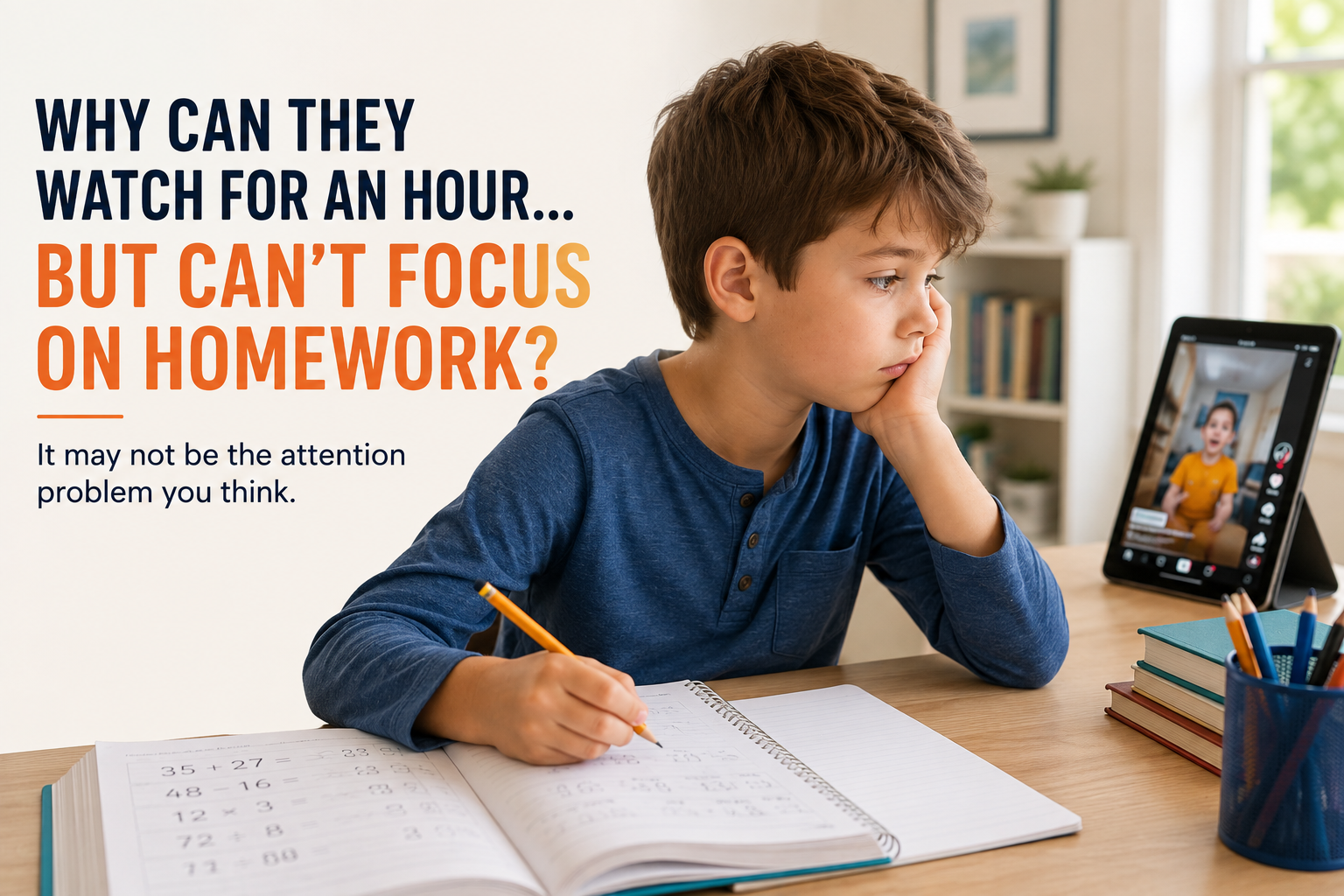
Many parents have seen the same strange contradiction.
Your child can sit in front of YouTube for 45 minutes, completely absorbed. Ask them to do ten minutes of homework, however, and suddenly they are thirsty, hungry, tired, looking for a pencil, checking something across the room, or telling you they simply cannot focus.
It is tempting to conclude that your child has a short attention span.
But that explanation misses something important.
Watching something that continuously captures attention and deliberately directing your own attention are not the same cognitive task.
Understanding that difference can change the way parents think about attention, screen time, homework, and even “brain rot.”
Your Child May Not Have an Attention Problem
When we say a child “can pay attention to YouTube,” we are describing what we can see: the child remains in front of the screen.
What we cannot see as easily is who is doing the work of maintaining that attention.
Many digital platforms continuously provide something new. A video changes scenes, music begins, a face appears, a joke lands, an animation moves across the screen, and another recommendation waits when the video ends.
The environment keeps giving the brain reasons to look again.
Homework works differently.
A math problem does not transform itself when a child becomes bored. A paragraph does not suddenly become louder or more colorful because attention has wandered. The worksheet simply waits.
To continue, the child has to bring attention back to the goal.
That difference matters.
Captured Attention and Directed Attention
A useful way for parents to think about attention is to distinguish between captured attention and directed attention.
Captured attention happens when something in the environment pulls us toward it. A sudden sound, movement, notification, new image, or unexpected event can do this automatically.
Directed attention works in the opposite direction. The child has a goal and tries to keep attention aligned with that goal, even when something else feels more interesting.
Reading a chapter, solving a multistep math problem, writing an essay, practicing piano, or building something complicated can all require this kind of sustained, goal-directed attention.
Both forms of attention are normal. Children need the ability to notice interesting things around them.
The problem arises when most of their entertainment experiences become exceptionally good at capturing attention, while everyday life continues to require them to direct it.
The American Academy of Pediatrics describes today’s digital ecosystem as increasingly shaped by engagement-oriented design. Features such as autoplay, algorithmic recommendations, intermittent rewards, and other design choices can encourage prolonged and repeated use.
That does not mean YouTube automatically damages attention. It means comparing “45 minutes watching videos” with “10 minutes doing homework” is not an apples-to-apples comparison.
Why Homework Feels So Much Harder
Consider what happens when a child watches a short video.
The next interesting event may arrive within seconds. If the content becomes boring, another video is immediately available. The child rarely has to create the stimulation.
Now consider a math problem.
First, the child must understand the instructions. Then they may need to remember information from the previous step, ignore distractions, select a strategy, calculate an answer, notice a mistake, and try again.
The reward may not arrive until several minutes later.
Homework therefore asks the brain to do more than simply “pay attention.” It can require working memory, inhibition, reasoning, planning, and persistence at the same time.
This is why a child who can watch a screen for an hour may still genuinely struggle to stay with homework.
The two activities demand different kinds of cognitive effort.
The Brain Likes What Comes Easily
Children are not unusual in preferring an immediate reward to a delayed one. Adults do it too.
Imagine reading a difficult report while your phone sits next to you. The report requires concentration. Your phone offers messages, news, videos, games, and social updates with almost no effort.
Which one does your brain want to check?
Children face the same competition, but the cognitive systems involved in self-regulation and goal-directed behavior are still developing.
This is one reason telling a distracted child to “just focus” often accomplishes very little.
They may understand exactly what you want them to do. The difficult part is maintaining the goal when another option offers faster stimulation or an easier reward.
Constant Switching Creates Another Challenge
The problem becomes even more complicated when children combine homework and entertainment.
A child starts an assignment, checks a message, watches part of a video, returns to homework, opens another tab, and then tries to remember where they left off.
Each switch can require the brain to reconstruct the original goal.
Research on youth media multitasking has found associations with aspects of cognitive control and academic performance, although researchers remain cautious about claiming that media multitasking itself causes those differences.
That distinction is important.
We do not need to tell children that multitasking is “destroying their brains.” A more practical lesson is enough:
Some tasks become easier when the brain is allowed to do one thing at a time.
During homework, simply moving the phone away, closing unnecessary tabs, and disabling nonessential notifications can change the attention environment without turning homework into a battle over technology.
Working Memory Can Get Lost in the Switch
Attention is only part of the story.
When children solve a problem, they often need to hold information in mind while doing something with it. Psychologists call this working memory.
For example, imagine doing 27 + 18 in your head. You need to keep parts of the calculation active while completing the next step.
Now imagine receiving a message halfway through.
When attention shifts, some of that temporarily held information may become harder to maintain. The child returns to the original task and has to reconstruct what they were doing.
Studies of media multitasking and memory have found associations between heavier media multitasking and differences in working-memory performance, although findings across the broader research literature are mixed and do not establish a simple causal relationship.
If your child frequently says, “I forgot what I was doing,” our article on working memory in children will look more closely at why this happens and what parents can do.
This Is Why “Less Screen Time” Is Only Part of the Answer
Parents often respond to attention problems by reducing screen time.
Sometimes that is useful, particularly when entertainment is replacing sleep, exercise, reading, schoolwork, or family interaction. The AAP specifically recommends looking at the broader digital ecosystem rather than treating all screen minutes as equivalent.
But removing a screen does not automatically teach a child how to sustain attention.
A child can spend an hour away from an iPad and still avoid difficult thinking.
The more important question is what experiences replace passive digital consumption.
Reading, building, drawing, solving puzzles, playing strategy games, practicing music, participating in sports, having conversations, completing household tasks, and working through challenging problems all ask children to actively engage with the world in different ways.
This is why we argue in Brain Rot in Kids: Why the Fix Isn’t Less Screen Time that parents should think beyond the number of minutes on a device.
The goal is not simply less screen.
It is more active thinking.
Help Your Child Practice Coming Back
Children will get distracted. Adults do too.
The goal is not to create a child who can stare at homework without ever looking away. A more realistic skill is learning how to recognize distraction and return to the original goal.
Parents can make that easier by creating short periods of focused work rather than demanding long stretches immediately. Removing unnecessary notifications and keeping only the materials needed for the task can also reduce competition for attention.
When children become stuck, give them a little time before providing the answer. Ask what they have tried or what they think the first step might be.
Most importantly, notice the return.
A child who becomes distracted and then comes back to the task is practicing something valuable.
That ability to return—to a goal, a problem, or an intention—is part of what we mean by cognitive resilience.
Attention Is Not Just Something Children Have. It Is Something They Use.
The fact that your child can watch YouTube for an hour does not prove that they should be able to concentrate on homework for an hour.
Those environments ask the brain to do different things.
One continuously offers reasons to keep watching. The other may require the child to create and maintain their own reason to continue.
Once parents understand this difference, the conversation can change.
Instead of asking, “Why can’t you focus?”, we can begin asking:
What is capturing your attention, and what will help you bring it back?
That may be a much more useful skill for children growing up in a world where increasingly sophisticated technologies compete for their attention every day.
Take the 60-Second Brain Rot Check
If you are wondering whether passive or fragmented digital content may be affecting your child’s attention and everyday routines, our short parent check looks at patterns involving attention, memory, task switching, and digital habits.
It takes about 60 seconds and helps parents observe patterns rather than diagnose a condition.
Brain rot is not a medical diagnosis, and the Brain Rot Check is not a clinical assessment.