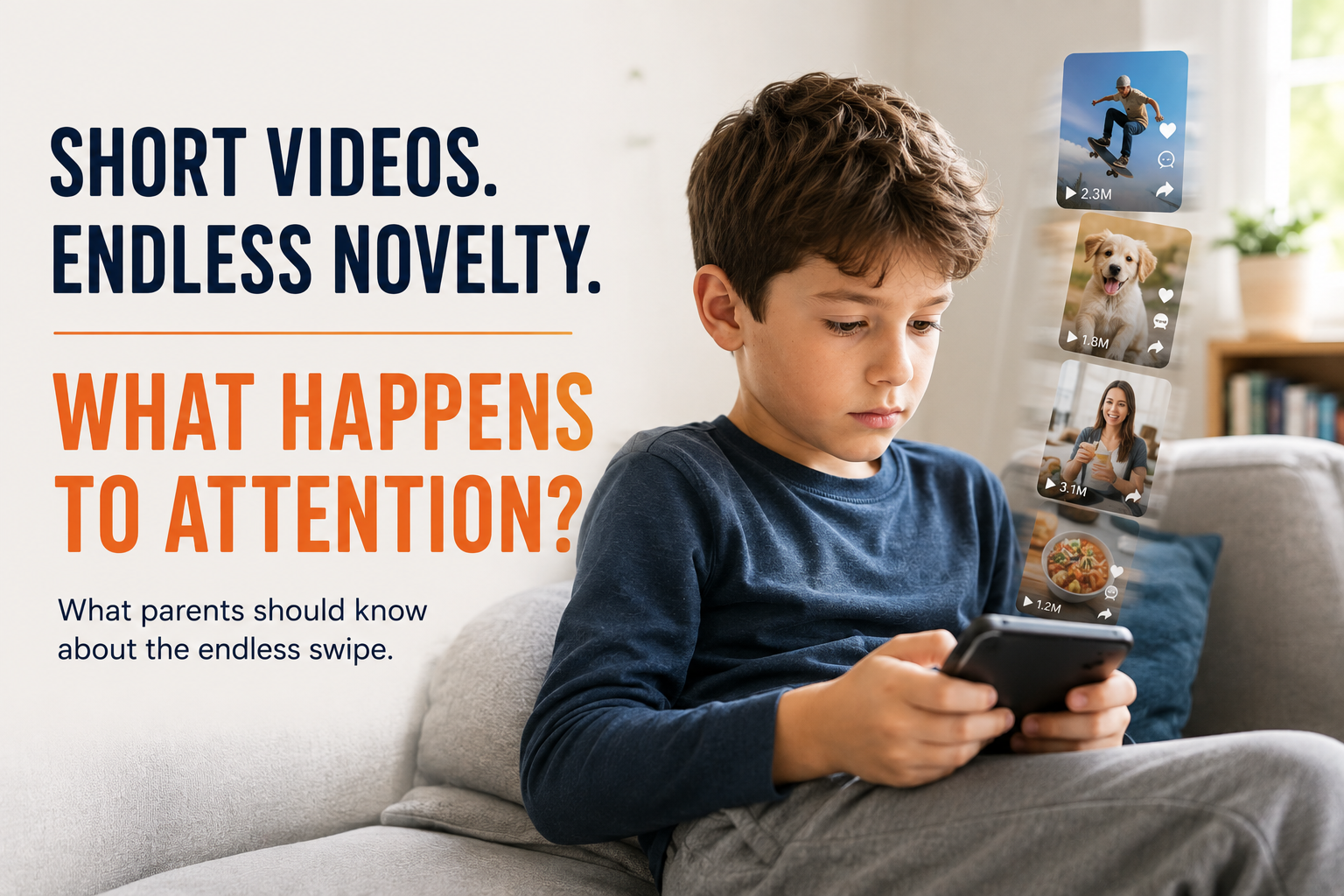
Short-form video has changed the rhythm of entertainment.
A child can move through dozens of ideas, faces, jokes, sounds, products, stories, and emotional reactions in just a few minutes. If one video does not capture their interest immediately, a swipe brings the next one.
For parents, this creates an understandable concern: What happens when a developing brain gets used to content that changes every few seconds?
You may hear claims that TikTok, YouTube Shorts, or Reels are “destroying children’s attention spans.” The science does not support such a simple conclusion. Researchers have found associations between patterns of digital media use and attention-related outcomes, but many studies cannot prove that short-form video itself causes attention problems.
Still, the question matters.
Instead of asking whether short videos are “ruining the brain,” parents may find it more useful to ask what kind of attention children repeatedly practice when entertainment becomes faster, more personalized, and easier to switch.
Short Videos Changed More Than Video Length
Short-form video is not simply television divided into smaller pieces.
Traditional television usually gives viewers a story selected by a broadcaster. Short-form platforms can continuously adapt what appears next based on a user’s behavior.
Watch something longer, swipe away quickly, replay a clip, like a video, or follow a creator, and those signals can help shape what comes next.
This creates an unusually responsive entertainment environment.
The American Academy of Pediatrics describes today’s digital ecosystem as increasingly influenced by engagement-oriented design. Features such as autoplay, personalized recommendations, notifications, and other mechanisms can encourage users to remain engaged.
For a child, the result can feel almost effortless: if this is not interesting enough, something else probably will be.
Novelty Is Powerful
Human attention naturally responds to change.
A new sound, movement, face, or unexpected event can pull attention toward it. This ability makes sense from an evolutionary perspective. Noticing something new in the environment can be useful.
Digital platforms did not invent this feature of the brain. They became very good at working with it.
Short-form video can deliver novelty at remarkable speed. Within a few minutes, a child may move from a joke to a dance, an animal clip, a gaming highlight, a science fact, an advertisement, and a dramatic story.
Each swipe creates another possibility.
That does not make novelty harmful. New experiences are essential to learning. The more relevant concern is whether children also spend enough time in environments where interesting things do not automatically arrive every few seconds.
What Happens When the Next Reward Is One Swipe Away?
Imagine reading a book that becomes slightly boring.
To continue, you have several choices. You can keep reading, think about what you just read, skip ahead, or put the book down.
Now imagine a video that becomes slightly boring.
One movement of your thumb replaces it.
That difference matters because many valuable childhood activities contain periods when nothing immediately rewarding happens.
Learning an instrument requires repetition. Reading a longer story includes slower passages. Building something can involve trial and error. Mathematics may require several unsuccessful attempts before the solution becomes clear.
Even conversation contains moments when someone else is speaking and you are waiting.
Children do not need to enjoy every boring moment. However, they do need opportunities to learn that a drop in stimulation does not always mean it is time to leave.
Does Short-Form Video Cause a Short Attention Span?
This is where parents should be careful with dramatic headlines.
Research has linked heavier or problematic digital-media use with various attention, self-regulation, sleep, and well-being outcomes in children and adolescents. However, the American Academy of Pediatrics’ technical review of digital media emphasizes the complexity of this evidence.
Children who already have difficulty regulating attention may also be more attracted to fast, stimulating digital environments. Sleep, family routines, stress, age, content type, platform design, and what media use replaces can all influence outcomes.
In other words, correlation can run in more than one direction.
So a parent should be skeptical of anyone claiming that watching a specific number of short videos will “rewire” a child’s brain in a predictable way.
The evidence is not that simple.
What parents can observe much more reliably is their own child’s behavior.
Watch the Transition After the Screen
One useful place to look is not during the video session but immediately afterward.
Suppose your child has spent 30 minutes watching short-form content. What happens when they move to homework, reading, dinner, or getting ready for bed?
Some children transition easily. Others become restless, complain that everything is boring, repeatedly ask for the device back, or struggle to settle into a slower activity.
That transition can tell you more than the screen-time number alone.
As we discussed in Why Can Kids Watch YouTube for an Hour but Struggle With 10 Minutes of Homework?, entertainment that continuously captures attention and a task that requires children to direct their own attention place different demands on the brain.
A child who struggles with the transition may not suddenly have an “attention disorder.” Their brain may simply be moving between two very different attention environments.
The Problem May Be Fragmentation, Not Just Duration
Parents often focus on how long children use screens. Another useful question is how fragmented that experience becomes.
Twenty minutes spent following one story is different from twenty minutes spent consuming dozens of unrelated clips.
The second experience repeatedly asks the child to disengage from one piece of information and orient toward something new.
Researchers studying media multitasking have investigated similar patterns of frequent switching and their relationship with cognitive control and memory. The findings are not simple enough to justify claims that switching permanently damages attention, but they do raise useful questions about how often we ask the brain to change targets.
This is one reason our discussion of digital overstimulation in kids focuses on everyday patterns rather than simply counting screen minutes.
Duration matters, but so do pace, content, context, and switching.
Short-Form Video Can Also Be Useful
Short videos are not inherently low quality.
A skilled teacher can explain an idea in 60 seconds. A science demonstration can spark curiosity. A music clip may inspire a child to learn an instrument. Humor can create shared moments between friends and families.
The format itself is not the enemy.
The distinction parents should consider is whether the child remains an active participant in the experience or falls into an extended stream of content that requires almost no decision beyond the next swipe.
One useful test is what happens afterward.
Does a video make your child curious enough to ask questions, create something, investigate a topic, or try an activity? Or does it mainly lead to another video, and then another?
The first pattern can open a door into the world.
The second can become a loop.
You Don’t Have to Ban Shorts
For most families, an absolute ban is unlikely to be the most useful starting point.
Clear boundaries can work better.
Parents might create defined viewing periods rather than allowing short-form video to fill every available moment. Turning off nonessential notifications and autoplay can restore some stopping points. Keeping devices away during homework and before sleep can also reduce competition with activities that require a different mental state.
It also helps to talk about the design itself.
Older children can understand a surprisingly sophisticated idea: the app is trying to keep you watching.
That conversation changes the relationship with technology. Instead of treating the child as the problem, parents can help them recognize how the environment influences behavior.
The goal is not fear. It is awareness.
Give the Brain Other Rhythms
Children need fast experiences and slow ones.
They need excitement, but they also need time to read a story that takes an hour to unfold. They need quick answers, but they also need problems that cannot be solved immediately. They need entertainment, but they also need play that begins with the question, “What should we do?”
A healthy digital life therefore does not have to mean eliminating short-form video.
It means making sure short-form video does not become the only rhythm the brain knows well.
If your child seems increasingly uncomfortable with slower activities, start by creating more opportunities for sustained engagement rather than simply lecturing them about screens.
Build something together. Cook a meal. Read. Draw. Play a strategy game. Work through a puzzle. Go somewhere without automatically bringing entertainment for every quiet minute.
These experiences give children something algorithms cannot provide for them: practice generating and maintaining their own engagement.
From Captured Attention to Cognitive Resilience
The larger issue behind the brain rot conversation is not whether children occasionally watch silly videos.
It is whether they can function well when the world stops entertaining them.
Can they stay with a goal when something becomes difficult? Can they tolerate a little frustration? Can they resist switching every time a new stimulus appears? After distraction, can they return to what they intended to do?
Those abilities are part of what we mean by cognitive resilience.
Children growing up with algorithms will not win by becoming better than technology at avoiding technology. They need to become better at deciding when technology deserves their attention and when something else matters more.
That is a much more useful goal than trying to raise a child who never watches another short video.
Take the 60-Second Brain Rot Check
If you are wondering whether passive or fragmented digital content may be affecting your child’s attention and daily routines, the Brain Rot Check looks at everyday patterns involving digital stimulation, task switching, memory, attention, and screen habits.
It takes about 60 seconds and is designed to help parents observe patterns rather than diagnose a condition.
Brain rot is not a medical diagnosis, and the Brain Rot Check is not a clinical assessment.