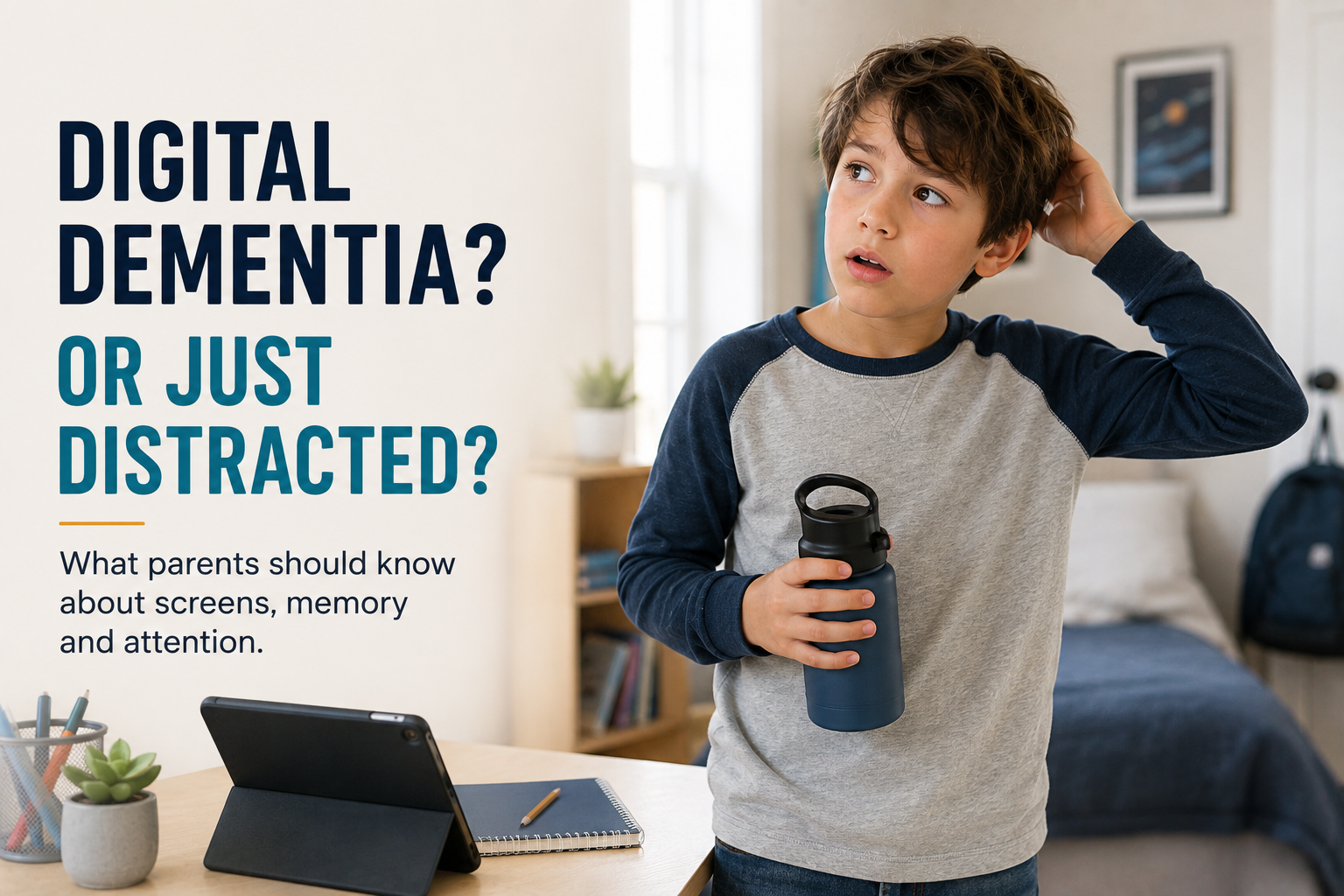
Your child walks upstairs to get something and comes back without it. They ask a question you answered five minutes ago. Homework gets interrupted by a notification, and suddenly they cannot remember what they were doing.
For parents already worried about screens, these moments can sound frighteningly similar to a phrase that has spread online: digital dementia.
The term suggests that heavy reliance on digital technology may weaken memory, attention, or thinking in ways that resemble cognitive decline. Put next to “brain rot,” it creates a powerful story: children are spending more time with technology, and their brains are paying the price.
But parents deserve a more careful explanation.
Digital dementia is not a medical diagnosis, and forgetting an instruction does not mean a child is developing dementia.
The more useful question is whether the digital environment is changing how often children practice remembering, concentrating, solving problems, and thinking for themselves.
Where Did “Digital Dementia” Come From?
The phrase became widely known through German psychiatrist and neuroscientist Manfred Spitzer, who used Digital Dementia as the title of his 2012 book about the possible cognitive consequences of relying heavily on digital technology.
Since then, the term has moved far beyond its original context. Today it often appears in articles, videos, and social posts describing everything from forgetfulness to shortened attention spans.
That creates a problem.
Dementia has a specific medical meaning. It refers to serious cognitive decline that interferes with everyday functioning and is generally associated with disease or injury. Calling ordinary childhood forgetfulness “dementia” can therefore make a complicated developmental question sound like a neurological disease.
Children who forget homework instructions after checking a phone are not experiencing the same process as an older adult with Alzheimer’s disease.
However, the popularity of the phrase points toward a legitimate question:
What happens when technology increasingly performs cognitive work that we once had to do ourselves?
Your Brain Has Always Used Tools
Humans have been outsourcing memory for thousands of years.
We write shopping lists because we do not want to remember twenty items. Calendars remember appointments. Maps tell us where to turn. Calculators handle arithmetic. Search engines retrieve information we once might have looked up in a book.
None of this automatically makes us less intelligent.
In many cases, cognitive tools free mental resources for more important work. A child does not need to memorize every historical date if they know how to find reliable information and understand what it means.
The issue becomes more interesting when outsourcing changes from supporting thinking to replacing thinking.
There is a difference between using a calculator after understanding multiplication and reaching for one before attempting 6 × 7. There is also a difference between asking AI to explain something you do not understand and asking it to complete the thinking before you have tried.
Technology is most useful when it extends cognition rather than automatically taking cognition’s place.
Memory Works Better When We Use It
Memory is not a storage container that simply fills up.
Remembering requires several processes. First, we have to pay enough attention for information to enter memory. Later, we need to retrieve that information when it becomes useful.
This is why distraction and memory often appear together.
Imagine telling your child, “Put your shoes upstairs, bring down your backpack, and fill your water bottle.”
Halfway upstairs, a notification appears.
The child checks it, watches something for a moment, and then arrives upstairs wondering why they went there.
It can look like a memory problem. But the interruption may have displaced the goal the child was trying to hold in mind.
That temporary mental workspace is called working memory, and it plays an important role in following instructions, mental arithmetic, reading comprehension, reasoning, and completing multistep tasks.
Children are still developing these abilities, which makes the environment around the task particularly important.
Sometimes “I Forgot” Really Means “I Was Distracted”
Parents often separate attention and memory, but the two work closely together.
If a child never fully attends to information, the brain has less information available to remember later.
Think about reading a page while repeatedly checking your phone. You may reach the bottom and realize you have almost no idea what you just read.
Your memory did not suddenly disappear.
Your attention kept leaving.
The same principle can affect children doing homework while messages, videos, games, browser tabs, and other stimuli compete for attention.
The American Academy of Pediatrics’ 2026 review of children’s digital environments notes that modern devices and platforms frequently use notifications, autoplay, infinite scrolling, and personalized recommendations to capture attention and prolong engagement.
This is one reason the question “Why is my child so forgetful?” sometimes needs another question beside it:
What was competing for their attention when they were supposed to remember?
The Research Is More Complicated Than “Screens Damage Memory”
Parents will find dramatic claims online suggesting that screen use causes cognitive decline in children.
The scientific picture is much less simple.
The AAP reports associations between excessive digital-media use in school-age children and weaker attention control, cognition, academic achievement, sleep, and other outcomes. At the same time, it emphasizes that children’s outcomes depend on many interacting factors, including the individual child, caregivers, content, design, context, and the broader digital ecosystem.
A 2026 review examining longitudinal research on screen use and executive function reached another important conclusion: the relationship appears to work in both directions. Higher or problematic screen use can predict later executive-function difficulties, while weaker executive function can also predict heavier or more problematic screen use.
That matters enormously.
A child who already struggles with impulse control or sustained attention may find highly stimulating digital environments especially attractive. Simply observing that the same child also uses screens heavily does not prove that the screen created the original difficulty.
The responsible conclusion is not “screens cause digital dementia.”
It is that the relationship between digital habits and developing cognitive abilities deserves attention without exaggeration.
What About Google and AI?
Technology has introduced another change that is easy to overlook: children can now get answers before they have spent much time trying to remember or reason.
Search engines made information instantly retrievable. Generative AI goes further by producing explanations, summaries, ideas, calculations, and complete responses.
That can be extraordinarily useful.
A child who does not understand photosynthesis can ask for another explanation. A student can explore a historical event from several perspectives. AI can provide feedback, examples, translations, and personalized support.
The concern is not access to answers.
It is when the answer arrives.
Suppose a child encounters a difficult problem and immediately asks AI to solve it. They receive the correct answer, understand it briefly, and move on.
Compare that with a child who first tries to recall what they know, tests an idea, gets stuck, changes approach, and then uses AI for help.
Both children used technology.
Only one spent significant time doing the cognitive work that came before the answer.
As AI becomes more capable, this distinction will become increasingly important.
Retrieval Is Part of Learning
Parents sometimes assume that if a child understands something once, learning has happened.
Memory does not work that way.
One of the ways knowledge becomes more accessible is through retrieval—trying to bring information back to mind rather than immediately looking it up.
That can happen naturally during everyday life.
“What did you learn about planets yesterday?”
“What do you think the next step is?”
“Can you remember what we need from the store?”
“What happened in the chapter you just read?”
These questions sound simple, but they ask the child’s brain to retrieve and organize information.
Parents do not need to turn dinner into an exam. The goal is simply to leave some room between the question and the answer.
A few seconds of thinking can sometimes be more cognitively valuable than another immediate search.
Don’t Confuse Convenience With Cognitive Weakness
Digital tools make many things easier, and easier is not automatically worse.
Nobody needs children to abandon GPS, calculators, search engines, or AI simply to prove that their brains still work.
The better question is whether convenience leaves enough opportunities for children to develop the underlying abilities those tools support.
A calculator is powerful when a child understands numbers.
GPS is powerful when a person still develops some sense of direction.
AI is powerful when a child can evaluate an answer rather than simply accept it.
Technology and cognition do not have to compete. The strongest combination may be a capable human mind using capable tools.
Watch for Patterns, Not a Scary Label
If your child seems increasingly forgetful, avoid jumping from ordinary behavior to “digital dementia.”
Start with context.
Are they sleeping enough? Do they forget instructions mainly when distracted? Are directions too long for their age? Is homework happening with several tabs and notifications open? Do they remember things that genuinely interest them? Has there been a sudden or significant change in their ability to function?
Children differ considerably in attention and memory, and many factors beyond technology can influence both.
If memory or attention problems are persistent, severe, worsening, or interfering substantially with school and everyday life, discussing them with your child’s pediatrician or another qualified professional makes more sense than trying to diagnose the cause from a screen-time report.
For everyday digital concerns, however, observation can reveal a great deal.
Our guide to 7 Signs Your Child May Be Getting Too Much Digital Stimulation offers a practical place to start.
From Digital Dementia to Cognitive Resilience
“Digital dementia” attracts attention because it describes what parents fear losing.
A more useful idea focuses on what we want children to build.
We call that cognitive resilience.
In a world where information is instant, children still need to hold a goal in mind. When answers are everywhere, they still need to reason. When algorithms compete for attention, they still need to decide where attention goes. When a tool can remember almost anything, they still need knowledge of their own.
The goal is not to raise children who can function without technology.
It is to raise children whose thinking remains active while using technology.
That distinction gives parents a very different direction.
Instead of asking, “How do I stop technology from making my child forgetful?”, try asking:
Where in my child’s day are they still being asked to remember, think, struggle, and figure things out?
Those moments may become increasingly valuable as digital tools become increasingly capable.
Take the 60-Second Brain Rot Check
If you are wondering whether passive or fragmented digital habits may be affecting your child’s attention, memory, or daily routines, the Brain Rot Check can help you look at the patterns.
It takes about 60 seconds and is designed to support observation, not diagnosis.
Brain rot and digital dementia are not medical diagnoses, and the Brain Rot Check is not a clinical assessment.