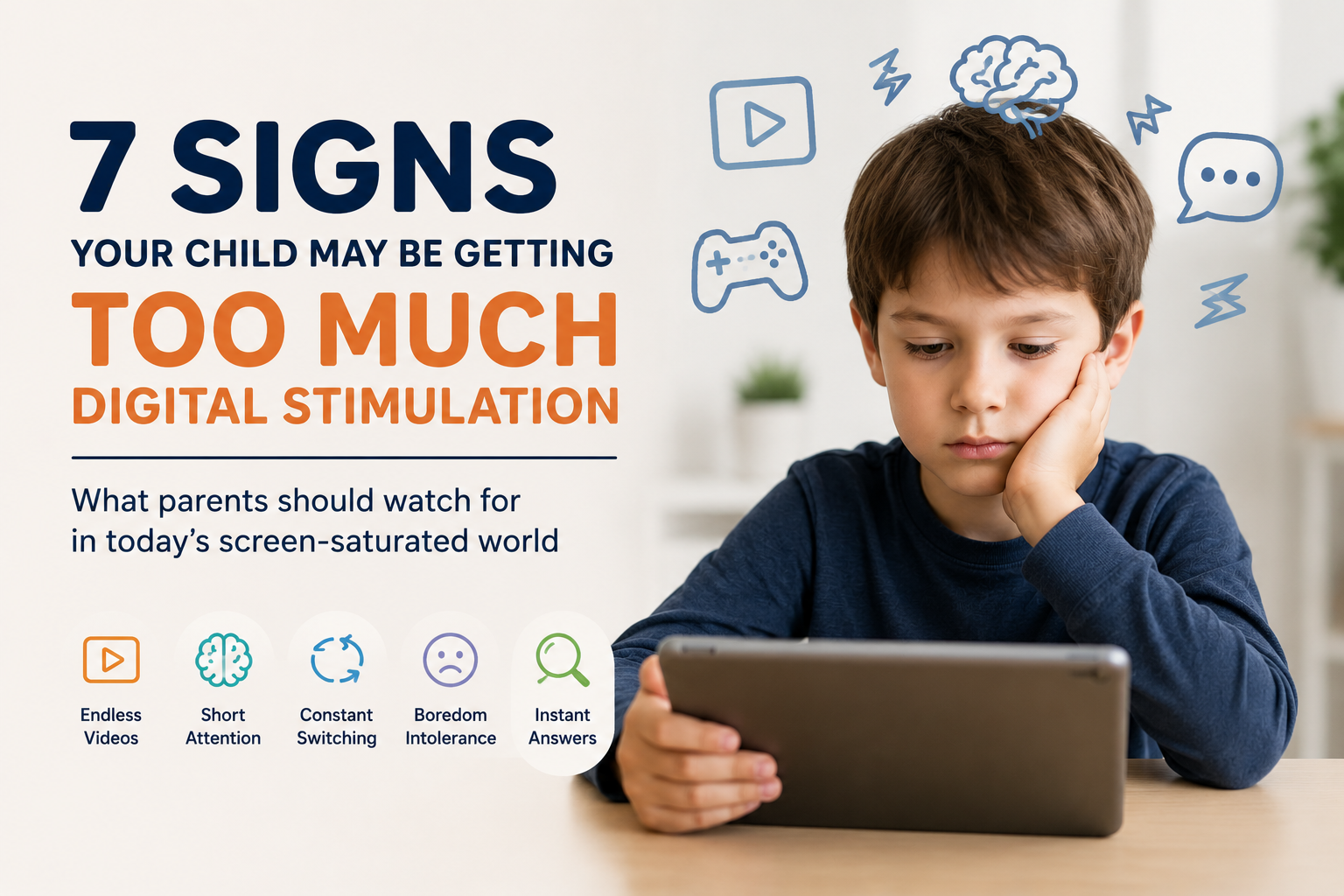
Your child puts down the tablet and immediately asks what they can watch next. Homework feels boring within minutes, but short videos can hold their attention much longer. A quiet car ride suddenly seems impossible without a screen.
None of these behaviors automatically means something is wrong. Children naturally seek stimulation, entertainment, and novelty. Digital media can also support learning, creativity, communication, and play.
The concern begins when highly stimulating digital experiences become so dominant that children have difficulty shifting into slower parts of everyday life.
Parents sometimes call this digital overstimulation. It is not a medical diagnosis. Instead, it is a useful way to describe a pattern in which a child becomes accustomed to frequent novelty, rapid rewards, constant entertainment, or repeated switching between digital activities.
Rather than counting individual behaviors as symptoms, parents can look for patterns. Here are seven worth noticing.
1. Stopping Is Much Harder Than Starting
Getting a child onto YouTube usually does not require much persuasion. Getting them off can be another story.
“One more video” becomes three. Finishing one episode leads immediately to another. Putting the device away may trigger arguments that seem out of proportion to what just happened.
Part of the challenge comes from the way many digital products work. Features such as autoplay, infinite feeds, notifications, and personalized recommendations reduce natural stopping points. The American Academy of Pediatrics discusses these engagement-oriented design features as part of the digital environment surrounding children.
The useful question is not whether your child ever complains when screen time ends. Most children will. Instead, notice whether stopping has become consistently difficult.
2. Every Quiet Moment Needs Entertainment
Think about the small empty spaces in your child’s day: riding in the car, waiting for food at a restaurant, standing in line, or having ten minutes before leaving the house.
What happens when nothing particularly exciting is going on?
If a screen immediately fills almost every quiet moment, children get fewer opportunities to decide what to do when nobody is entertaining them.
Boredom can feel uncomfortable, but it also creates space for children to observe, imagine, talk, daydream, invent games, or simply sit with their own thoughts. Parents do not need to deliberately make children bored, but they also do not need to eliminate boredom every time it appears.
3. Slower Activities Feel Increasingly Difficult
A familiar parent puzzle looks like this: your child watches videos for 40 minutes without complaint, but after ten minutes of homework, you hear, “I can’t focus.”
That does not necessarily mean your child lacks the ability to pay attention.
Fast digital entertainment and homework create very different attention environments. Videos can continuously introduce new sounds, images, characters, and topics. If one piece of content becomes boring, another arrives almost instantly.
Reading, homework, drawing, practicing an instrument, and solving a difficult problem usually require the child to generate more of that attention internally.
We explore this difference in more detail in Why Can Kids Watch YouTube for an Hour but Struggle With 10 Minutes of Homework?.
The pattern to watch is not whether your child prefers entertainment to homework. That is hardly unusual. Instead, notice whether slower activities that they once enjoyed are becoming increasingly difficult to tolerate.
4. They Keep Switching Between Activities
Homework begins. Then comes a message. Next, your child checks a video, opens another tab, returns to the assignment, and suddenly asks, “Where was I?”
Digital devices make switching effortless, but the brain still has to keep track of the original goal.
Frequent switching can place additional demands on attention and working memory, especially during tasks that already require several pieces of information to remain active at once. A child may look busy for 30 minutes while spending surprisingly little uninterrupted time on the original task.
Try watching the pattern rather than immediately correcting it. How long can your child stay with one activity before switching? More importantly, how easily can they return to the original task afterward?
5. They Want the Answer Before They’ve Tried
A child encounters a difficult question and almost immediately says, “Google it,” “Ask AI,” or simply, “Tell me.”
Instant access to information is one of the great advantages of growing up today. Children should learn how to search for information and use AI effectively.
However, knowing how to find an answer and knowing how to think through a problem are not the same skill.
Children also need opportunities to spend some time in the uncomfortable space between “I don’t know” and “I figured something out.” That is where they test ideas, notice patterns, make mistakes, change strategies, and learn what kind of help they actually need.
The goal is not to prevent children from using technology for answers. It is to make sure technology does not always arrive before the thinking begins.
6. They Frequently Lose Track of What They Were Doing
You ask your child to go upstairs, get their backpack, and bring down a water bottle. Five minutes later, they return with neither.
During homework, a brief interruption leads to, “Wait, what was I doing?”
Everyone forgets things, and children are still developing the cognitive abilities involved in following instructions and maintaining goals. But frequent interruptions can make this harder by adding new information while the child is still trying to hold onto the original task.
One of the abilities involved is working memory, the mental workspace we use to temporarily hold and work with information.
Parents can help by reducing unnecessary interruptions during demanding activities, giving shorter instructions, and allowing children to finish one step before adding several more.
7. Screens Are Pushing Important Things Out
This may be the most useful sign of all because it moves the conversation away from whether screens are simply “good” or “bad.”
Ask what screen use is replacing.
Is entertainment regularly pushing bedtime later? Is it reducing physical activity, reading, outdoor play, conversation, creative activities, or time with friends and family?
The American Academy of Pediatrics encourages families to consider what media may be “crowding out” rather than relying only on a universal screen-time number.
Context makes a difference. Thirty minutes of entertainment after a child has slept well, moved their body, finished schoolwork, and spent time with family is very different from the same 30 minutes when it repeatedly replaces something important.
Don’t Count Symptoms. Look for Patterns.
Loving YouTube does not mean your child has a problem. Neither does complaining about homework, forgetting an instruction, or getting upset when it is time to stop playing a game.
Children are children.
Instead of treating these seven signs as a checklist for diagnosing something, look at the bigger pattern. Can your child stop when needed? Do they still enjoy slower activities? Can they spend some time without constant entertainment? Are they able to stay with a problem before searching for the answer? Does technology fit into their life, or is the rest of life increasingly being organized around technology?
If you are concerned about these patterns, our What Is Brain Rot? A Parent’s Guide explains why the issue is more complicated than simply counting screen-time minutes.
From Digital Stimulation to Cognitive Resilience
The long-term answer cannot be removing every stimulating experience from childhood. Children are growing up in a digital world, and technology will remain part of learning, entertainment, communication, and eventually work.
A more realistic goal is helping children develop greater control over how they respond to that environment.
We describe this as cognitive resilience: the growing ability to direct attention, hold a goal in mind, tolerate some frustration, think before reacting, change strategies, and return to a task after distraction.
Parents do not need to eliminate every distraction to help build these abilities. Small changes matter. Protect some quiet moments. Create clearer stopping points for entertainment. Reduce unnecessary switching during homework. Leave room for children to struggle with a question before providing the answer.
The goal is not to make childhood less interesting.
It is to help children remain capable of deciding what deserves their attention.
Take the 60-Second Brain Rot Check
If you are wondering how digital habits may be affecting your child’s everyday routines, our short parent check looks at patterns involving passive digital content, attention, memory, task switching, and daily activities.
It takes about 60 seconds and is designed to help you observe patterns, not diagnose a condition.
Brain rot and digital overstimulation are not medical diagnoses, and the Brain Rot Check is not a clinical assessment.